

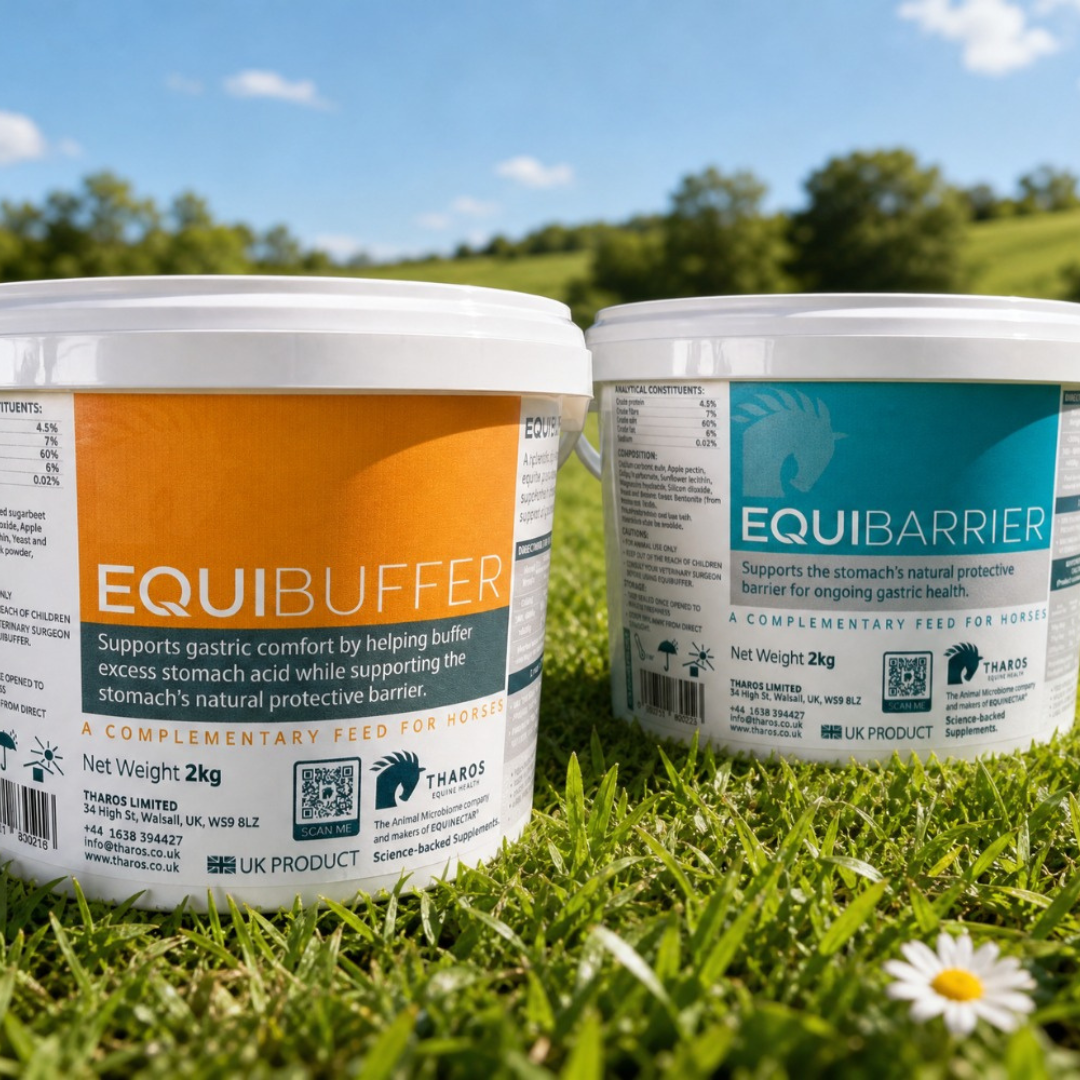
EquiNectar remains our foundation. But many of our customers also feed something aimed specifically at the stomach, and those products tend to fall into two camps: acid buffers and barrier-support formulas. I wanted us to offer both, properly formulated, not two more generic gut powders bolted on for the sake of a wider range. That's what led to EquiBuffer and EquiBarrier.
Three products, three jobs
- EquiNectar digests the feed itself, reducing what reaches the hindgut and supporting fibre digestion.
- EquiBuffer targeted support where excess gastric acidity is the concern.
- EquiBarrier ongoing support for the stomach's natural protective barrier.
They're complementary, not interchangeable. Not every horse needs all three; the point of the range is that owners can pick the support that fits their horse.

EquiBuffer: targeted support for gastric acidity
The stomach produces acid continuously, whether or not the horse is eating. Normal forage access, chewing and saliva production keep this in check. Problems tend to show up when forage intake is interrupted, meals get bigger, exercise intensity rises, or travel and routine changes disrupt normal feeding behaviour. EquiBuffer is built for those periods.
Calcium carbonate and magnesium hydroxide do the core buffering work. Both are established antacid minerals: calcium carbonate neutralises gastric acid on contact and can temporarily raise stomach pH[1], and equine studies of magnesium hydroxide show the same short-term effect[2]. Neither comes close to the prolonged acid suppression of veterinary medicines, which is why we describe EquiBuffer as buffering support rather than treatment. We use both together for a broader mineral-buffering system rather than relying on one source.
Apple pectin and sunflower lecithin support the physical barrier between stomach contents and the mucosal surface: pectin hydrates into a gel-like matrix, lecithin supplies phospholipids for the hydrophobic protective surface. A study of 24 horses found significant lesion improvement with a pectin-lecithin complex[3], and work in Standardbred racehorses[4] and feed-deprivation models in ponies[5] has reported the same benefit. We chose sunflower over soya lecithin simply to avoid soya in the formulation. As with any nutritional ingredient, results depend on feeding rate and how severe the gastric challenge is, so we describe pectin and lecithin as supporting the stomach's natural protective environment rather than as a cure for gastric ulceration.
Selected yeast components contribute beta-glucans and mannan-rich cell-wall fractions, studied for their interaction with the intestinal immune system. Equine research is thinner here than in some other species, but controlled work on beta-glucan supplementation during experimentally induced inflammatory challenge supports its place as a nutritional ingredient[6], short of any claim that it treats gastric lesions directly. It broadens EquiBuffer beyond simple acid neutralisation.
The rest of the formula does the practical work. Dried sugar beet pulp is a highly digestible, low-starch fibre that also acts as a carrier, giving a consistent powder that mixes well into feed; research shows beet pulp can shift the composition of the faecal microbiota[7], though the amount here is about giving the active ingredients a horse-appropriate base, not replacing forage. Fenugreek is there for palatability, one of the most readily accepted flavours in controlled preference studies[8], because a well-researched product is worthless if the horse won't eat it. Silicon dioxide, in a very small quantity, keeps the powder flowing and evenly mixed through manufacture and use. Not glamorous, but it's why every scoop is the same as the last.

EquiBarrier: daily support for the stomach's natural barrier
EquiBuffer leans toward acid buffering. EquiBarrier is for horses needing ongoing support for the stomach's protective barrier, whether that's a daily formula run alongside EquiNectar long-term, or targeted use during travel, competition or periods of routine change. It carries the same apple pectin and sunflower lecithin combination described above, backed by the same research, but here it's the centrepiece rather than one part of a wider formula. Calcium carbonate is still present but plays a smaller, supporting role rather than the main event it is in EquiBuffer. Sugar beet pulp, fenugreek and silicon dioxide serve exactly the same carrier, palatability and manufacturing roles as they do in EquiBuffer.
What's different is bentonite, a naturally occurring clay made largely of smectite minerals including montmorillonite. Its layered structure gives it a large surface area and the ability to adsorb, not absorb, water and other substances in the digestive tract. That distinction matters: absorption pulls something inside a material, adsorption is binding to the surface, and it is bentonite's surface properties that make smectite clays widely used binding agents. Research confirms considerable adsorptive capacity for bentonite and montmorillonite[9], and animal studies have looked at their interaction with intestinal contents and the mucosal barrier, but much of this isn't equine-specific gastric research, so we're not claiming bentonite is proven to treat equine gastric disease. It's included for additional binding and physical support within the gut, and it's also why EquiBarrier shouldn't be fed alongside certain macrolide antibiotics: adsorptive clays can interact with orally administered substances.

Why not just one product?
We could have combined every ingredient into a single "universal" gastric supplement. We didn't, because a horse needing short-term acid buffering doesn't necessarily need the same formula as one whose owner wants ongoing barrier support. Splitting them gives each product a clear job, and gives owners the choice to feed what their horse actually needs rather than everything at once.
Evidence-led, not evidence-cherry-picked
"Science-backed" shouldn't mean finding one favourable paper and ignoring the rest. The research behind equine gastric supplements is genuinely mixed. Calcium carbonate and magnesium hydroxide have a clear, measurable acid-neutralising effect[1,2]. Pectin and lecithin have produced encouraging results in some equine trials and not in others[10]. That doesn't make them worthless, it means we have to describe them accurately.
EquiBuffer and EquiBarrier are complementary feeds that support normal digestive function. They are not medicines and not substitutes for veterinary investigation, gastroscopy remains the correct way to diagnose equine gastric disease, and any horse showing persistent pain, poor performance, weight loss, appetite change or altered behaviour needs a vet, not a supplement. What we can offer is a range built on logical mechanisms, carefully chosen ingredients, realistic claims and the best evidence currently available. That's the natural next step for EquiNectar: not a departure from the product that remains our foundation, but a more complete approach to equine digestive support built around it.
References
- Woodward, M.C., Huff, N.K., Garza, F., Keowen, M.L., Kearney, M.T. and Andrews, F.M. (2014) Effect of pectin, lecithin, and antacid feed supplements (Egusin) on gastric ulcer scores, gastric fluid pH and blood gas values in horses. BMC Veterinary Research, 10(Suppl 1), S4.
- Clark, C.K., Merritt, A.M., Burrow, J.A. and Steible, C.K. (1996) Effect of aluminum hydroxide/magnesium hydroxide antacid and bismuth subsalicylate on gastric pH in horses. Journal of the American Veterinary Medical Association, 208, 1687-1691.
- Venner, M., Lauffs, S. and Deegen, E. (1999) Treatment of gastric lesions in horses with pectin-lecithin complex. Equine Veterinary Journal, Supplement 29, 91-96.
- Ferrucci, F., Zucca, E., Croci, C., Di Fabio, V. and Ferro, E. (2003) Treatment of gastric ulceration in 10 standardbred racehorses with a pectin-lecithin complex. Veterinary Record, 152, 679-681.
- Murray, M.J. and Grady, T.C. (2002) The effect of a pectin-lecithin complex on prevention of gastric mucosal lesions induced by feed deprivation in ponies. Equine Veterinary Journal, 34(2), 195-198.
- Lacerenza, M.D., Arantes, J.A., Reginato, G.M., Passarelli, D., Balieiro, J.C.C., Amaral, A.R., Vendramini, T.H.A., Brunetto, M.A. and Dória, R.G.S. (2024) Effects of β-glucan supplementation on LPS-induced endotoxemia in horses. Animals, 14(3), 474.
- Ford, T., McAdams, Z.L., Townsend, K.S., Martin, L.M., Johnson, P.J. and Ericsson, A.C. (2023) Effect of sugar beet pulp on the composition and predicted function of equine fecal microbiota. Biology, 12(9), 1254.
- Goodwin, D., Davidson, H.P.B. and Harris, P. (2005) Selection and acceptance of flavours in concentrate diets for stabled horses. Applied Animal Behaviour Science, 95(3-4), 223-232.
- Kihal, A., Rodríguez-Prado, M. and Calsamiglia, S. (2022) The efficacy of mycotoxin binders to control mycotoxins in feeds and the potential risk of interactions with nutrient: a review. Journal of Animal Science, 100(11), skac328.
- Sanz, M.G., Viljoen, A., Saulez, M.N., Olorunju, S. and Andrews, F.M. (2014) Efficacy of a pectin-lecithin complex for treatment and prevention of gastric ulcers in horses. Veterinary Record, 175(6), 147.