01
Introduction
We've all seen it…a horse that pins its ears at feeding time, paws impatiently at the stable floor, or seems inexplicably irritable despite being well cared for. For years, many horse owners and trainers attributed these behaviours to personality quirks or poor training. But emerging research is painting a far more complex and fascinating picture: your horse's emotional state, the way they express it through their face and body, and even their behaviour problems may be deeply intertwined with what's happening in their gut.
02
Reading the Horse's Face: What Science Now Tells Us
Groundbreaking research published in PLOS ONE has demonstrated that AI can now recognise distinct emotional states in horses simply by analysing their facial expressions, with 76% accuracy across four states: baseline, positive anticipation, disappointment, and frustration (1). The study built upon earlier work by Ricci-Bonot and Mills (2), who used the Horse Facial Action Coding System (EquiFACS) to identify specific facial markers associated with frustration and disappointment during feeding.
What's particularly striking about these findings is when these emotions occur: around food. Horses experiencing frustration (defined as a high-arousal negative state when an expected reward is withheld) showed increased eye white visibility, ear rotation, head turning, and biting of the feeder (2). Disappointment, a lower-arousal negative state, was characterised by blinking, nostril lifting, tongue showing, chewing, and licking (2).
These aren't random behaviours. They are measurable, scientifically validated signals that your horse is experiencing emotional distress, and crucially, this distress is often rooted in the feeding environment. The researchers themselves noted that the pre-feeding period may not be a positive experience for many horses, and could in fact be a persistent source of frustration (2).
Now ask yourself: if your horse's gut is uncomfortable, what does that feeding experience feel like to them?
03
The Gut–Brain Connection in Horses
The equine digestive system is extraordinary in its complexity…and its fragility. Horses evolved as trickle feeders, consuming small amounts of fibrous forage almost continuously across 16–18 hours per day. Modern management practices (bucket meals, high-starch concentrate feeds, limited turnout, and restricted roughage) place enormous strain on a system that was never designed for them.
When digestion is compromised, the consequences ripple outwards. Poor starch digestion in the small intestine means that undigested carbohydrates pass into the hindgut, where they are rapidly fermented by bacteria. This produces volatile fatty acids and gas, disrupts the delicate microbial balance, and can lead to hindgut acidosis, discomfort, and inflammation.
Research has now established a compelling link between gut microbiota composition and horse behaviour. A large-scale study of 185 sport horses tracked over eight months found that behavioural indicators of a compromised welfare state, including stereotypies, hypervigilance, and aggressiveness, were all significantly associated with gut microbiota composition (4). The microbiability (the proportion of behavioural trait variance explained by the gut microbiome) was estimated at 24.2% for oral stereotypies and 16.2% for locomotion stereotypies (4). In other words, over a quarter of the variation in crib-biting behaviour could be linked back to what was happening in the gut.
The same study found that specific bacterial genera were directly correlated with welfare-impairing behaviours: horses expressing oral stereotypies harboured higher abundances of certain bacteria including Acinetobacter, Roseburia, and Helicobacter, whilst those showing aggressive behaviours had higher levels of lactate-producing genera such as Streptococcus and Butyrivibrio (4). The authors noted that oral stereotypies (which often arise as coping mechanisms in response to feeding frustration and restricted movement) may themselves modify the gastrointestinal environment through stress hormone release, further altering microbial composition in a troubling feedback loop (4).
This is the microbiota–gut–brain axis in action: a bidirectional conversation between the digestive system and the central nervous system that influences mood, arousal, and behaviour.
04
Why Gut Health is a Welfare Issue
The welfare implications of this are significant. A qualitative study by Cheung, Mills, and Ventura (3) explored the attitudes of equestrians towards performance horse welfare and uncovered a troubling pattern: many horse owners were aware of welfare issues, including stress, agitation, and restricted management, yet justified or trivialised them as normal parts of equestrian culture. One participant put it plainly: "That's still 20 hours a day in a box, right? And that kills me sometimes. But my horse is well cared for."
The researchers identified this as cognitive dissonance, the uncomfortable gap between knowing something is potentially harmful and continuing the practice anyway (3). Enculturation within equestrian culture, they argued, perpetuates management norms that may chronically compromise horse welfare, including those that directly impact gut health: restricted forage access, high-concentrate diets, limited social interaction, and prolonged stabling.
When we link this to the facial expression and microbiome research, a fuller picture emerges. Horses living in these conditions are more likely to experience gut dysbiosis and discomfort. Gut disruption is associated with negative emotional states and welfare-impairing behaviours (4). Those negative states are visibly expressed - in flattened ears, white eyes, nostril tension, and biting at feeders (2) - yet these signals are often dismissed as behavioural problems rather than recognised as what they may truly be: signs of genuine physiological and emotional distress.
Recognising these facial and behavioural cues as potential indicators of digestive discomfort is not just scientifically sound - it is a fundamental act of responsible horsemanship.
05
Where EquiNectar Comes In
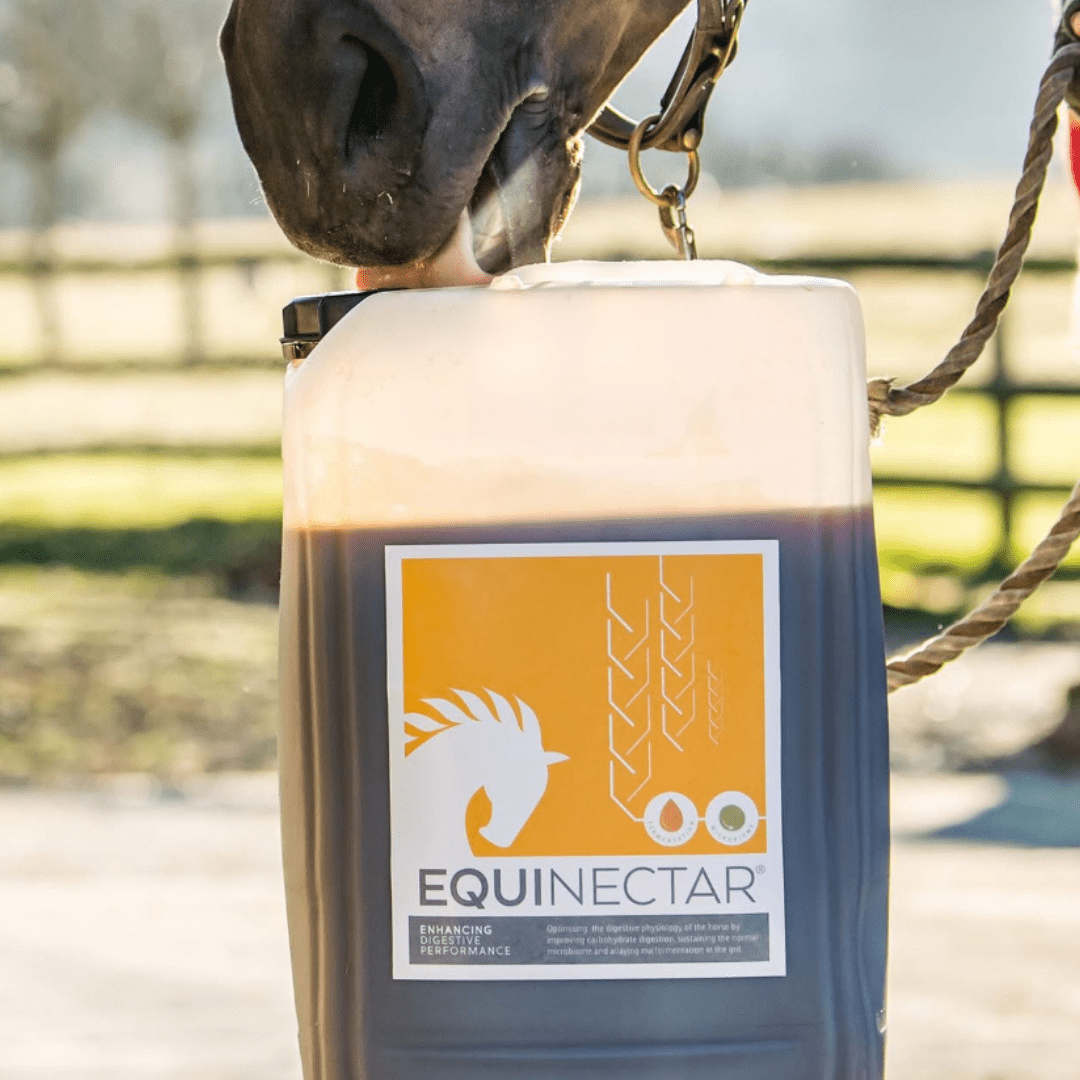
Supporting your horse's digestive health is one of the most impactful steps you can take for their overall wellbeing.. EquiNectar is a digestive syrup made from malted barley that delivers a range of active digestive enzymes directly into your horse's feed.
Recent clinical trial data demonstrates that EquiNectar doesn't just "mask" behavioural issues - it modulates the underlying physiological triggers through a specific Lactate Clearance Mechanism. Here's how each mechanism works:
1. Neutralising the "Unpredictable" Pasture Trigger
Your horse's facial expressions of frustration are often rooted in the feeding experience. While pasture is "natural," grass fructan concentrations can fluctuate widely (between 10% and 50%) depending on daily weather patterns such as cold nights and sunny days. These spikes can create unpredictable hindgut stress.
The Modulation: EquiNectar's fructanase pre-digests variable fructan loads before they reach the hindgut.
The Result: This helps prevent acute lactate spikes and pH crashes that may contribute to agitation, ear-pinning, and "grass-sensitive" irritability observed in many pastured horses.
2. Resolving the "Hindgut Fuel Crisis"
Horses expressing chronic GI sensitivity or inconsistent performance may be experiencing a hidden "fuel crisis" within the gut lining.
The Modulation: In clinical trials, EquiNectar produced a 100% universal increase in butyrate levels across healthy subjects, with relative increases ranging from +55% up to +395%.
The Result: As the primary energy source for colonocytes (cells lining the large intestine), this increase in butyrate provides the fuel required for meaningful barrier support and enhanced GI comfort.
3. Modulating the Internal Environment
Elevated lactate levels can contribute to an acidic hindgut environment. This may suppress beneficial bacteria and destabilise the microbial ecosystem.
The Modulation: EquiNectar modulates this environment by suppressing lactate-producing bacteria, reducing Lactobacillus by up to 90% in dysbiotic subjects. At the same time, it activates lactate-utilising species such as Selenomonas, which increased in 100% of healthy subjects during trials.
The Result: This shifts the hindgut from a potentially acidic, unstable state toward a more balanced, energy-producing ecosystem. In severely dysbiotic horses, this corresponded with an 80% recovery of propionate, a short-chain fatty acid involved in immune and metabolic regulation.
4. Improving Mineral Bioavailability
Beyond carbohydrate digestion, EquiNectar's phytase enzyme breaks down phytic acid in plant-based feeds, the compound that binds and blocks the absorption of key minerals including phosphorus, calcium, and magnesium. Chronically low mineral availability can impair muscle function, nerve signalling, and overall metabolic stability. By unlocking these nutrients at the point of digestion, EquiNectar helps ensure horses derive the full mineral value from every meal, supporting physical comfort and reducing a hidden source of nutritional stress that may otherwise go undetected.
5. Maximising What Your Horse Gets From Forage
Hay and forage form the cornerstone of every horse's diet, yet their nutritional value is only as good as your horse's ability to digest them. EquiNectar's cellulase, xylanase, and beta-glucanase enzymes break down the structural cell walls of plant material that horses cannot fully digest on their own. This means more energy and nutrients are released from every kilogram of roughage, supporting gut fill, extending the slow fermentation that healthy hindgut bacteria rely on, and reducing the risk of the "forage gap" that leaves horses hungry, anxious, and prone to stereotypies between meals.
EquiNectar’s contains:

- Amylase targets starch, a nutrient horses have limited natural ability to digest, given they did not evolve on grain-heavy diets. Supplemental amylase helps break down cereal starch before it reaches the hindgut, reducing the fermentation load that contributes to gas, bloating, and acidosis - and potentially the agitation that comes with it.
- Fructanase breaks down fructans, the complex sugars found in pasture grasses - a particular concern during periods of lush growth and a known trigger for hindgut upset.
- Phytase improves the bioavailability of essential minerals like phosphorus and calcium by breaking down phytic acid, which otherwise binds and blocks their absorption from plant-based feeds.
- Cellulase, xylanase, and beta-glucanase all work to improve the digestibility of forage and hay, the cornerstone of every horse's diet - helping your horse extract maximum nutritional value from their roughage.
Together, these enzymes support the growth of beneficial gut bacteria, contribute to improved dropping consistency, reduce the risk of gas production and bloating, and may help reduce the agitation and irritability that stems from hindgut discomfort. EquiNectar also contains all B vitamins, with notably high levels of folate and niacin, which support overall metabolic health.
The inclusion of B vitamins is particularly relevant for horses under training or competition stress. Niacin plays a key role in energy metabolism and maintaining healthy skin and coat condition, while folate supports red blood cell production and DNA repair. Horses in heavy work or on restricted pasture access may have elevated B vitamin requirements, and EquiNectar's malted barley base provides a naturally fermented, bioavailable source of these nutrients alongside its enzyme activity.
For horses who display tension, irritability, or negative facial expressions at feeding time, addressing potential digestive discomfort is a logical and compassionate first step. Research shows that a balanced gut microbiome is meaningfully linked to calmer, more settled behaviour (4). A horse whose gut is working efficiently is far better placed to experience the feeding period as a positive event, rather than a source of frustration or distress.
06
Connecting the Dots: Emotion, Expression, and Digestion
The science is clear. Horses experience distinct emotional states. They express those states through measurable changes in their faces and bodies (1, 2). Many of those states - particularly frustration and discomfort around food - are connected to the digestive experience. And underlying gut dysfunction, including shifts in microbial composition, may be fuelling both the physical discomfort and the behavioural signals we observe every day (4).
As veterinary behavioural science advances and tools like EquiFACS make emotional recognition more accessible, horse owners are increasingly empowered to look beyond behaviour as a training problem and ask: what is my horse actually feeling, and why?
For competition horses in particular, the stakes are high. A horse whose hindgut is acidic, whose microbial balance is tipped toward lactate-producing species, and whose butyrate availability is insufficient to maintain gut barrier integrity is not only uncomfortable, they are also likely operating below their physiological and cognitive potential. Performance inconsistency, resistance under saddle, and poor focus in the arena may all have roots in the same internal environment that drives feeding frustration and ear-pinning at the stable door. EquiNectar's clinically evidenced modulation of these specific mechanisms offers a targeted, non-invasive tool for owners and trainers seeking to optimise not just digestive health, but the full expression of their horse's capability and temperament.
If your horse is showing signs of digestive discomfort - whether through loose droppings, girthiness, poor appetite, or behavioural changes around feeding - EquiNectar offers a practical, evidence-informed way to support their gut health from the inside out.
Because a horse with a healthy gut is not just a horse that digests well. It is a horse with a better chance of feeling well, too.
07
Conclusion: Addressing the Biological Drivers
The "cognitive dissonance" often felt by equestrians (the gap between providing high-standard care and observing persistent agitation or distress) can be reframed through a biological lens.
Clinical evidence for ERME modulation suggests that many outward signs of frustration may reflect physiological responses to hindgut instability or transient lactate accumulation, rather than behavioural traits.
By addressing these internal imbalances, we move beyond symptom management and towards supporting the horse's underlying digestive physiology. Helping your horse feel comfortable internally may positively influence behaviour, performance and overall wellbeing ,restoring the feeding period to the positive experience it was intended to be.
References
(1) Feighelstein, M., Riccie-Bonot, C., Hasan, H., Weinberg, H., Rettig, T., Segal, M., Distelfeld, T., Shimshoni, I., Mills, D. S., & Zamansky, A. (2024). Automated recognition of emotional states of horses from facial expressions. PLOS ONE, 19(7), e0302893. https://journals.plos.org/plosone/article?id=10.1371/journal.pone.0302893
(2) Ricci-Bonot, C., & Mills, D. S. (2023). Recognising the facial expression of frustration in the horse during feeding period. Applied Animal Behaviour Science, 265, 105966. https://www.sciencedirect.com/science/article/pii/S0168159123001387
(3) Cheung, E., Mills, D., & Ventura, B. A. (2025). "But my horse is well cared for": A qualitative exploration of cognitive dissonance and enculturation in equestrian attitudes toward performance horses and their welfare. Animal Welfare, 34, e50. https://www.cambridge.org/core/services/aop-cambridge-core/content/view/6FF0114E2170F90E2AA50D671F56B8FE/S0962728625100286a.pdf/div-class-title-but-my-horse-is-well-cared-for-a-qualitative-exploration-of-cognitive-dissonance-and-enculturation-in-equestrian-attitudes-toward-performance-horses-and-their-welfare-div.pdf
(4) Mach, N., Ruet, A., Clark, A., Bars-Cortina, D., Ramayo-Caldas, Y., Crisci, E., Pennarun, S., Dhorne-Pollet, S., Foury, A., Moisan, M. P., & Lansade, L. (2020). Priming for welfare: gut microbiota is associated with equitation conditions and behavior in horse athletes. Scientific reports, 10(1), 8311. https://doi.org/10.1038/s41598-020-65444-9
ABOUT EQUINECTAR
Description
EquiNectar® is a natural feed supplement, that is scientifically proven to:
- Re-balance your horse’s gut bacteria
- Help your horse maximise benefits from its feed
- Improve your horse’s condition
More information
EquiNectar® is produced by Tharos Ltd in the UK. It is a natural source of digestive enzymes and contains only the following ingredients:
- Our patented enzyme rich malt extract
- Medium chain triglycerides (from coconut oil)
- Potassium sorbate
For more details of the enzymes within EquiNectar® take a look at the ingredients and enzymes page.
How to feed
Simply add EquiNectar® to your horse's daily feed, using the Feeding Rate chart to determine the correct amount.
For detailed instructions about how to introduce EquiNectar, please read the comprehensive Feeding Guide page.